
Affiliate Disclosure — Content Notice — Legal Disclosures — Newsletter — Home — Bottom of Post
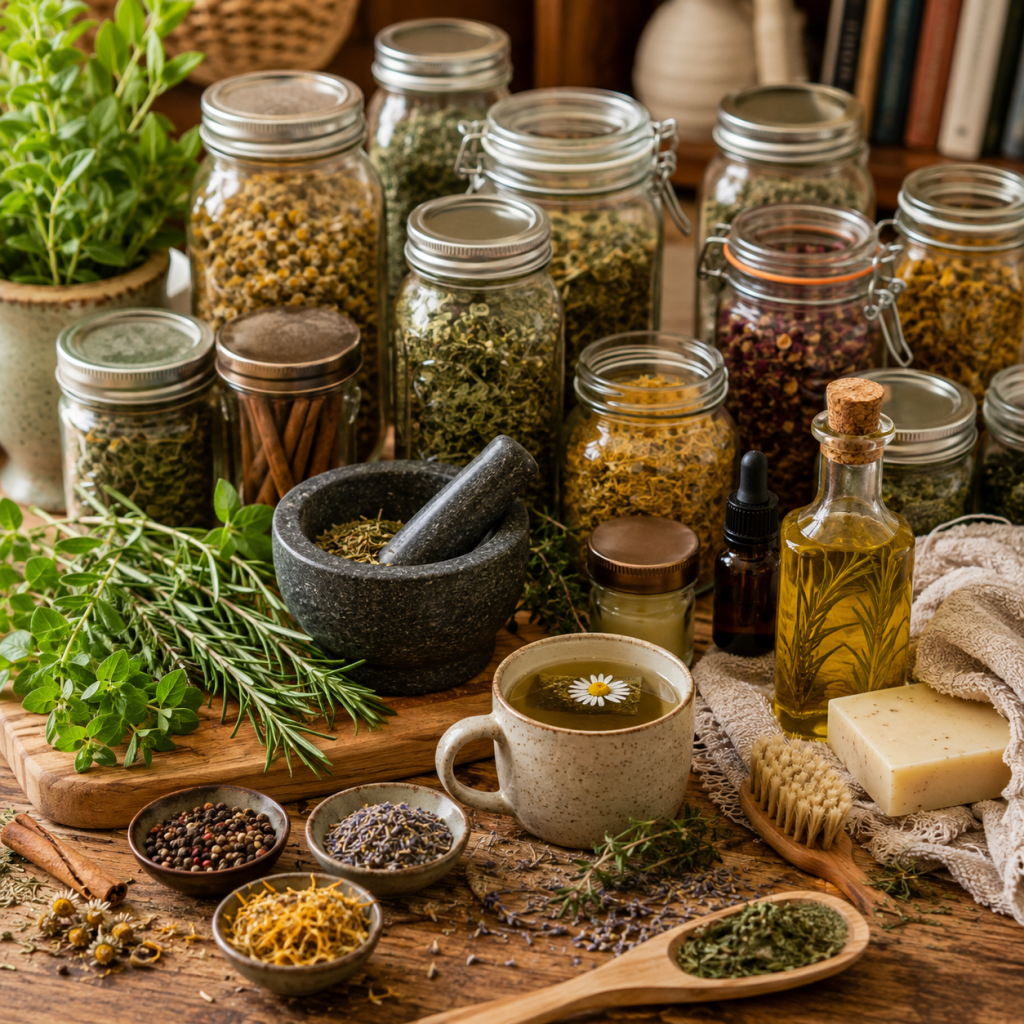
Where Food, Wellness & Everyday Care Meet
When I say Kitchen Apothecary, you might picture rows of little amber bottles.
Maybe bundles of dried herbs hanging from the ceiling.
Tiny drawers with mysterious handwritten labels.
A mortar and pestle sitting somewhere nearby, because apparently every respectable apothecary requires one.
Mine doesn’t quite look like that…though I do have a mortar and pestle.
Mine looks like three rather full kitchen cupboards.
Large-family problems.
There are quart jars of herbs and teas. Spices and homemade seasoning blends. Oils. Supplemental food powders. Gluten-free pantry ingredients. Trim Healthy staples. Ingredients I cook with. Things I drink. Things I steep. Things I occasionally put on my hair or skin instead of in my mouth.
And probably something shoved behind something else that I forgot I bought.
It’s a working cupboard.
Because my Kitchen Apothecary isn’t really about creating an aesthetic.
It’s about keeping useful things within reach.
Build Yours Slowly
You don’t need to order twenty herbs after reading this.
Please don’t.
Start with what you already use.
Look at your spice cupboard.
Your tea collection.
Your pantry.
Your oils.
Your favorite seasonings.
The ingredients you reach for when someone doesn’t feel well.
The things you use for your hair or skin.
The foods that help your family navigate its particular boundaries.
You may discover you’ve already begun building an apothecary without calling it one.
Pick one thing.
Learn about it.
Learn how you like to use it.
Notice whether it actually earns a place in your home.
Then, if curiosity leads you somewhere else, learn about the next thing.
One jar at a time is plenty.
You’ll occasionally find affiliate links throughout Life in the Treehouse. If something has become a trusted part of our home, I may share it here. Purchasing through those links costs you nothing extra, but helps support our family and the work I love creating.
Affiliate Disclosure — Content Notice — Legal Disclosures — Newsletter — Home — Bottom of Post—TOP
What Is an Apothecary, Anyway?
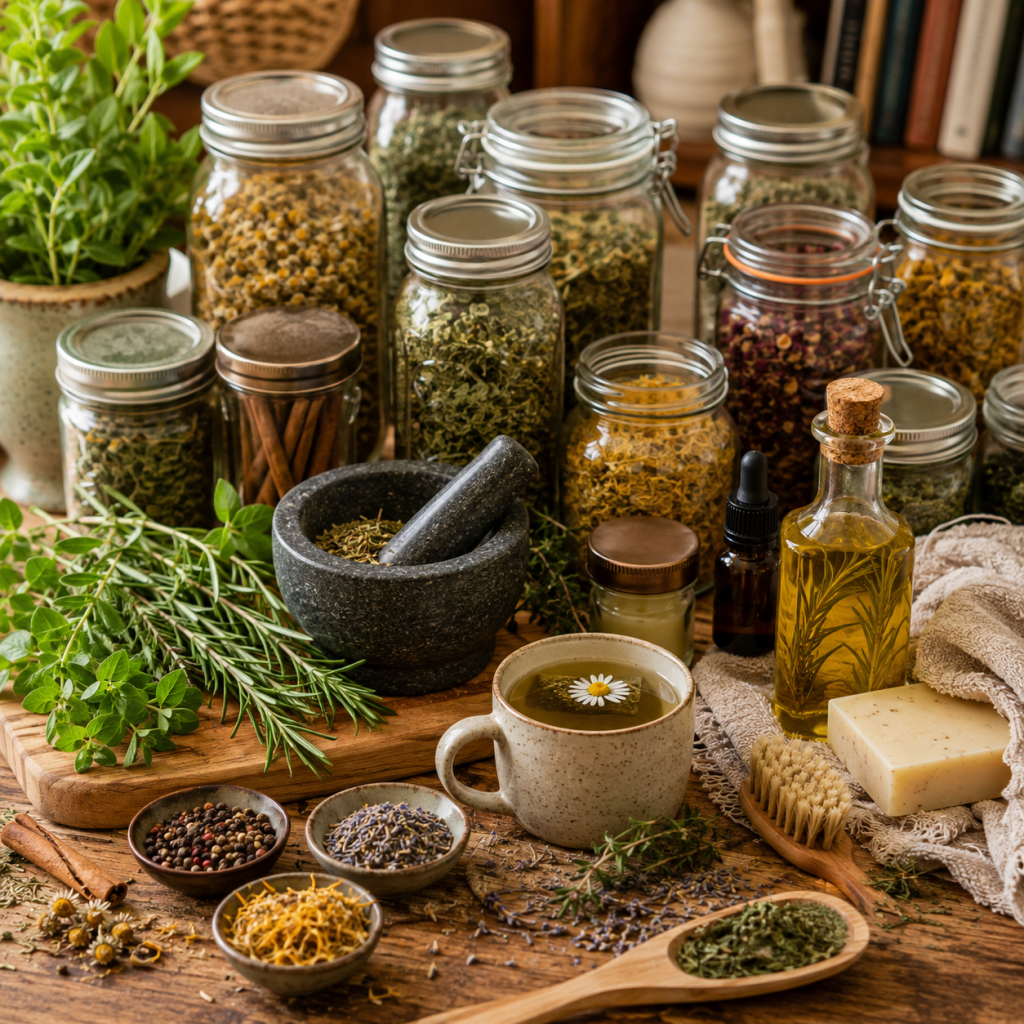
Traditionally, an apothecary was a person who prepared and sold medicines, or the shop where those preparations and their ingredients could be found.
It was a predecessor of the modern pharmacy.
Herbs, roots, spices, extracts, oils, preparations, and remedies lived there because they were tools people used in caring for the body.
That’s useful history.
But when I use the word apothecary, I’m not pretending my kitchen is a pharmacy.
And I’m definitely not suggesting that everything in a jar is medicine.
The Treehouse version is much more ordinary.
An apothecary is a collection of useful things you have gathered, learned about, prepared, and actually know how to use in caring for yourself and the people in your home.
For me, the kitchen became the natural place for that collection.
Because the kitchen is one of the great intersections of my home.
The Kitchen Apothecary Is Really About Stewardship
The more I’ve thought about it, the more I’ve realized that this isn’t ultimately a series about herbs.
It’s about stewardship.
Learning what I have.
Understanding what it can do.
Knowing its limitations.
Using it thoughtfully.
Avoiding unnecessary waste
Choosing ingredients that can serve my actual household.
And slowly building a body of knowledge I can draw from when I need it.
I’m not trying to build a household where I can do everything myself.
I’m building one where we have useful tools, useful knowledge, and enough flexibility to respond to ordinary life.
Sometimes that means a homemade seasoning blend.
Sometimes it’s soup.
Sometimes it’s tea.
Sometimes it’s a gluten-free pantry staple.
Sometimes it’s an oil.
Sometimes it’s an herb I’ve spent time learning about.
And sometimes it’s knowing that what is happening requires something entirely outside my kitchen cupboard.
Knowing the limits of a tool is part of knowing how to use it.
Affiliate Disclosure — Content Notice — Legal Disclosures — Newsletter — Home — Bottom of Post—TOP
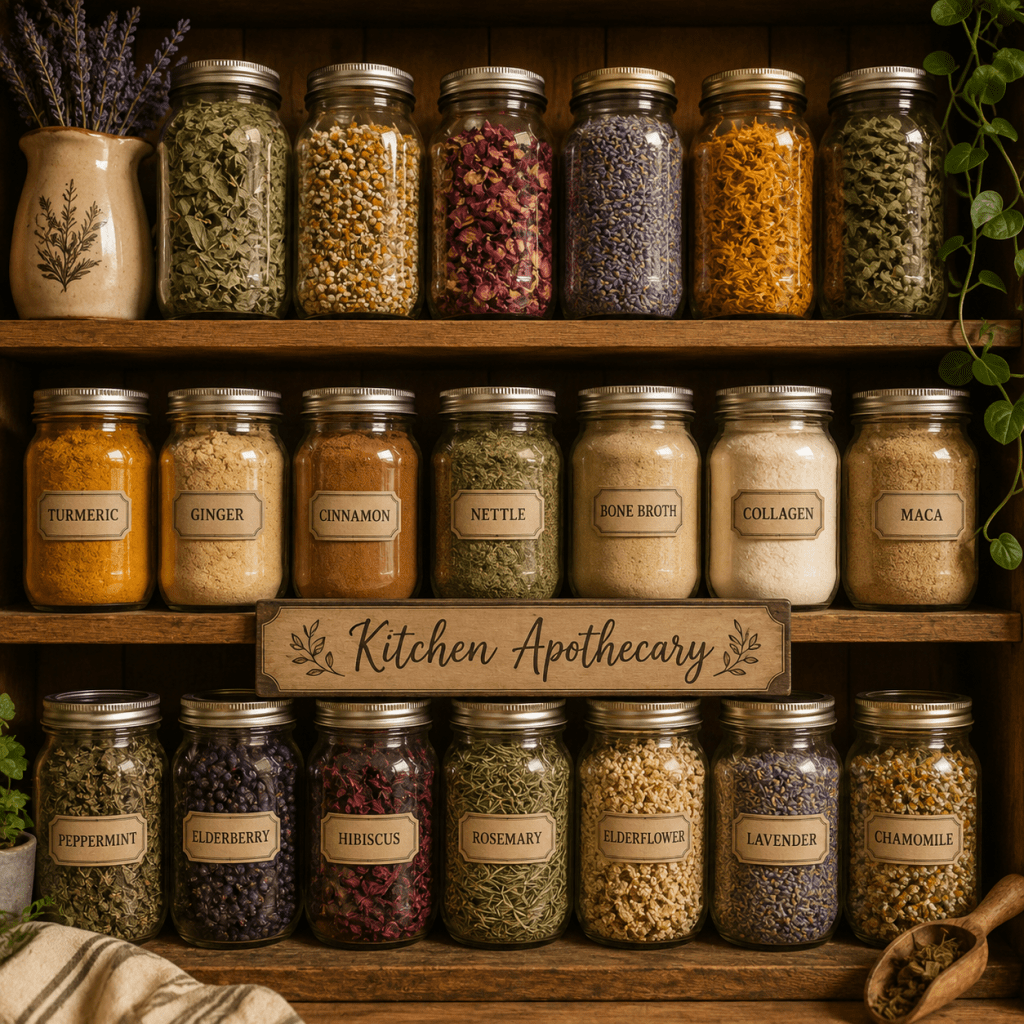
Welcome to My Kitchen Apothecary
This part of the Treehouse will keep growing because my own cupboards and knowledge keep growing.
I’ll share herbs.
Teas.
Spices and seasoning blends.
Oils.
Pantry ingredients.
Supplemental foods and powders.
Recipes & Body-care uses.
Things I’ve made myself because it was practical.
Things I happily buy because making everything myself is not a requirement for being a functional human being.
And, most importantly, I’ll share what I’ve learned along the way.
Not because I think my cupboards should become your cupboards.
But because sometimes seeing what another person has learned gives us a place to begin asking better questions about our own lives.
Your Kitchen Apothecary should serve your life—not become another lifestyle you’re required to serve.
Mine happens to take up three cupboards. Yours doesn’t have to.
Use what serves you.
And let it grow from there.
Why the Kitchen?
So much care passes through a kitchen.
We feed people there.
We make tea there.
We prepare food when someone is sick.
We fill water bottles.
We make birthday cakes.
We pack lunches.
We wash scraped knees at the sink.
We make the foods that accommodate someone’s boundaries.
We make comfort food.
We make ordinary Tuesday-night food.
We stand at the counter and talk about things that have absolutely nothing to do with food.
In my house, the kitchen isn’t simply where cooking happens.
It is one of the places care happens.
So it makes sense to me that my apothecary lives there too.
Affiliate Disclosure — Content Notice — Legal Disclosures — Newsletter — Home — Bottom of Post—TOP

Food and Wellness are Never Separate Cupboards for Me
One of the things I want to do with this series is broaden what we mean when we talk about an apothecary. And here’s where the name becomes a little misleading.
My Kitchen Apothecary includes the ingredients I use to season dinner.
Because mine isn’t just herbs, and the ingredients may live in my kitchen, they don’t necessarily stay there.
Tea leaves may travel to the bathroom for hair care.
An infused preparation may become part of skin care.
Something from the pantry might be used for a soak.
Some ingredients support nourishment.
Some support flavor.
Some simply create pleasure, comfort, ritual, or familiarity.
Not everything needs to become a treatment.
Not everything needs a wellness claim attached to it.
Some things simply make ordinary life better.
Sometimes I’m not trying to optimize anything.
And sometimes the exact same ingredient belongs in several of those sentences.
That’s one of my favorite things about it.
Affiliate Disclosure — Content Notice — Legal Disclosures — Newsletter — Home — Bottom of Post—TOP
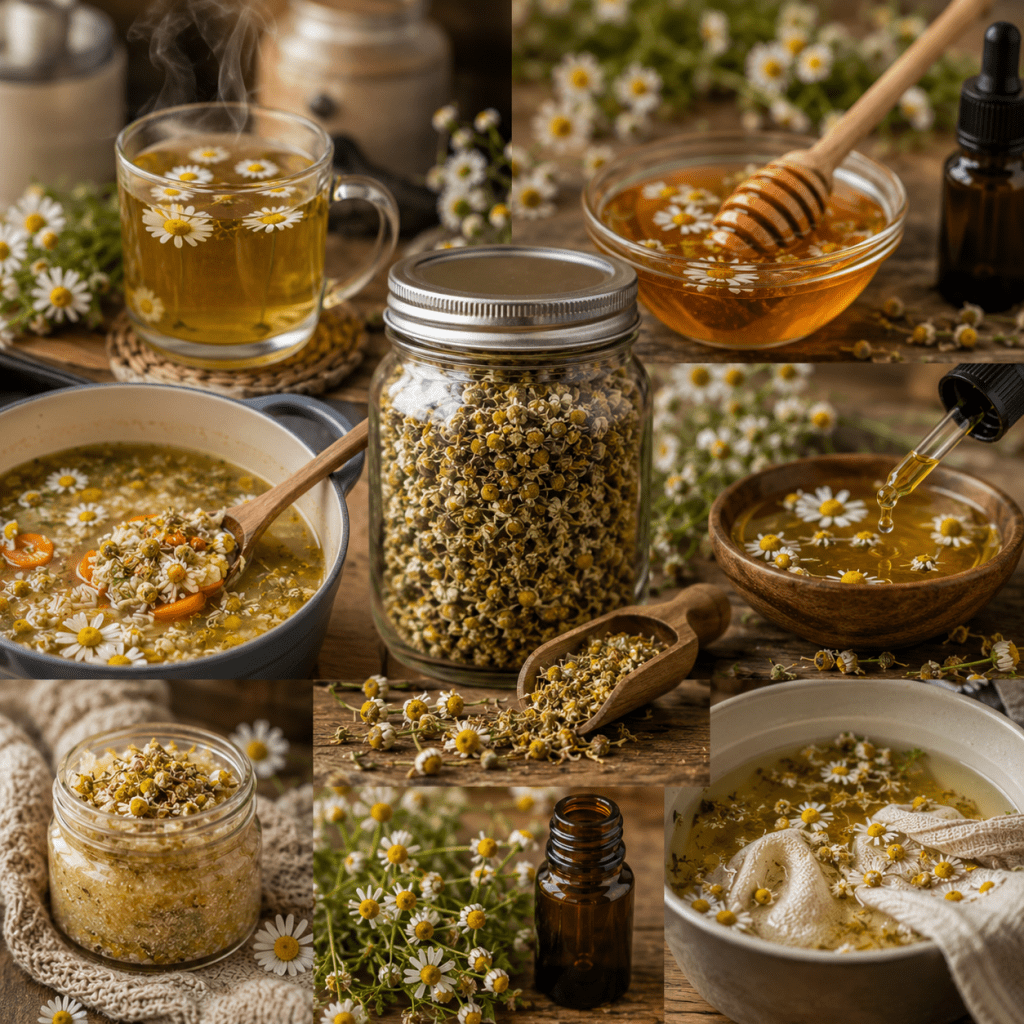
One Ingredient. More Than One Job.
I like multi-use things.
Partly because they’re practical.
Partly because I enjoy understanding how things work.
And partly because when ten people live in one house, space is always a factor.
If something can earn its place in my cupboards in more than one way, even better.
An herb might season dinner.
The same herb might become tea.
A tea I drink may also be useful in a hair rinse, facial steam, bath, soak, or another form of external body care.
An oil might be part of cooking and also have a place in skin or hair care.
A pantry ingredient might be there because it helps us live within our family’s food boundaries while also making everyday meals easier.
That doesn’t mean every ingredient needs seventeen purposes before it’s allowed through the front door.
It means I don’t feel compelled to separate food, wellness, and body care into entirely different worlds when real life often allows them to overlap.
I want to understand the things I keep.
Then I want to use them.
Affiliate Disclosure — Content Notice — Legal Disclosures — Newsletter — Home — Bottom of Post—TOP
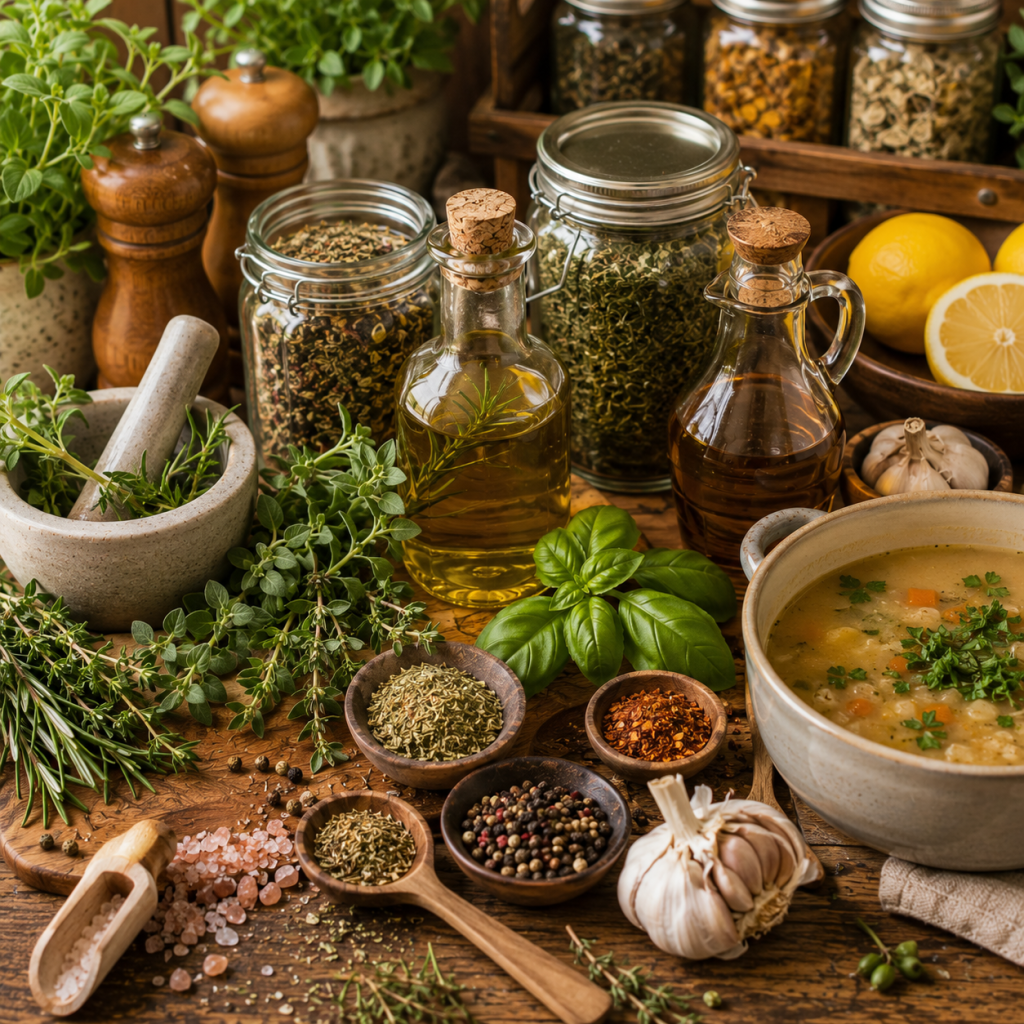
Herbs Are an Enhancement, Not an Entire Way of Eating
This matters to me.
Herbs can be wonderful.
But herbs aren’t a substitute for nourishment.
They’re an enhancement to a way of eating that may already include all sorts of needs and boundaries.
My own food choices are also influenced by the Trim Healthy lifestyle.
Your boundaries may look completely different.
That’s okay.
The question isn’t:
What is supposed to be in an apothecary?
A better question is:
What helps me care for the people who actually live here?
And when we’re talking specifically about herbs and spices:
What flavors make the food we actually eat taste amazing?
Season it to your liking.
Build around your food.
Your family.
Your budget.
Your available space.
Your boundaries.
Your preferences.
Your current season.
That’s far more useful than trying to duplicate somebody else’s shelf.
Affiliate Disclosure — Content Notice — Legal Disclosures — Newsletter — Home — Bottom of Post—TOP
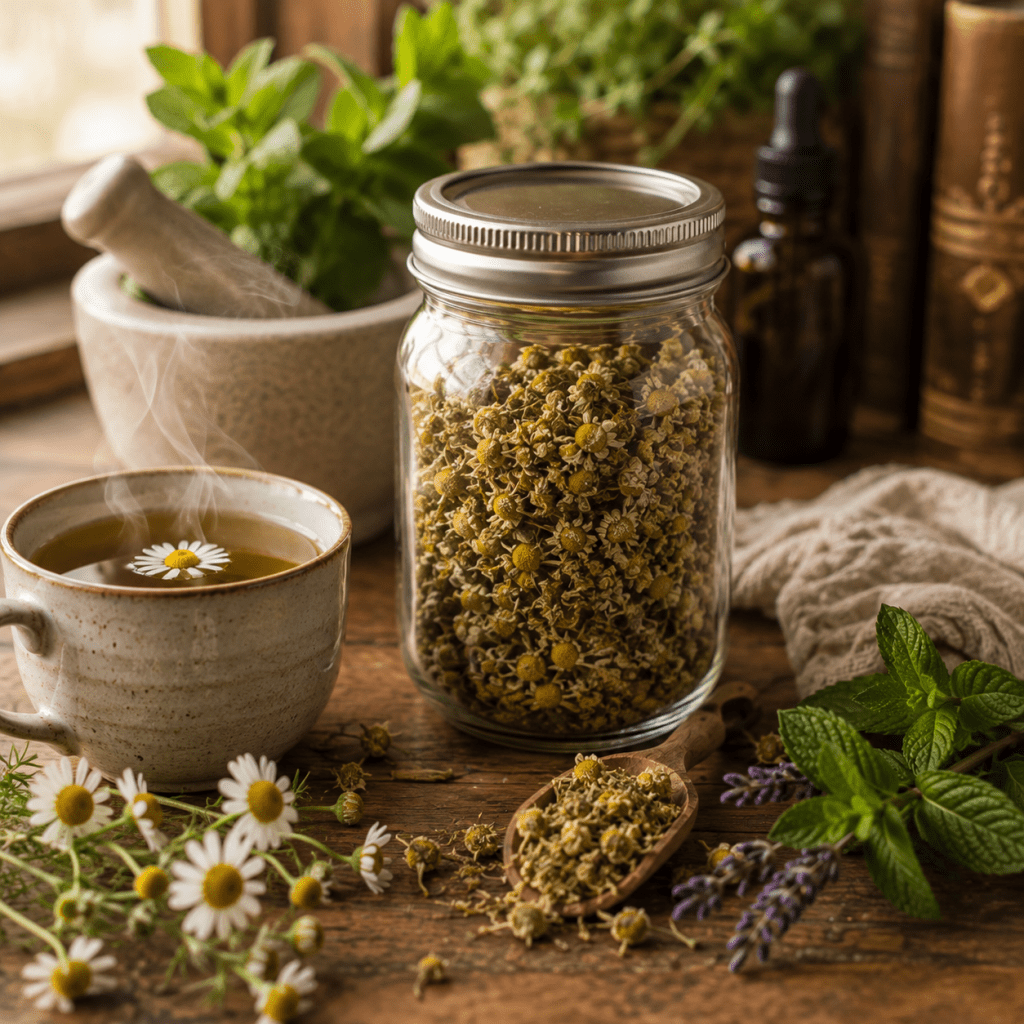
Your Apothecary Might Be One Jar
Mine takes up three cupboards.
That doesn’t make mine better.
It mostly means I have a large family, use these things frequently, and have been collecting knowledge and ingredients over time.
Your Kitchen Apothecary could be one shelf.
A basket.
A drawer.
A tea box.
A windowsill.
Or one jar.
I genuinely believe one herb—even black tea or coffee—can be an apothecary if it is something you understand and actually use.
I’d rather see someone know one herb well than own fifty herbs they don’t know what to do with.
This isn’t about collecting your way into wellness.
It’s about learning.
Garam Masala Seasoning Blend
Curry Powder
Homemade Bouillon Mix
Powdered Sweetener Blend
Stinging Nettle Infusion
Explore the Kitchen Apothecary Series
From Dependency to Understanding
That’s also why I don’t want this series to become:
“Nicole says I need this herb.“
That’s not the goal.
I want to show you what lives in my cupboards, why it earned a place there, how I use it, what I’ve learned about it, and where I think caution or additional research belongs.
Then you get to decide whether any of that information is useful in your life.
That’s The Treehouse Standard.
Affiliate Disclosure — Content Notice — Legal Disclosures — Newsletter — Home —TOP



Nicole Burch is a Trim Healthy Lifestyle Coach, author, and holistic family life mentor helping women and families rebuild through rooted rhythms, personal governance, and sustainable living. Blending nourishment, discernment, and restoration, she guides others toward resilience, peace, and healing—creating lives that are grounded, aligned, and nurtured at home.
Wellness That Withstands.
Rooted. Resilient. Restored.
Affiliate Disclosure — Content Notice — Legal Disclosures — Newsletter — Home —TOP
Trim Healthy Coach Disclaimer
Nicole Burch is a Certified Trim Healthy Mama Lifestyle Coach, independently offering services based on the THM plan. This coach is not an employee or agent of Trim Healthy Mama, LLC. Coaching services are independently managed, and THM is not responsible for results, business practices, or claims made by this coach.
Affiliate Disclosures
As an Amazon Associate, I may link to specific products that I believe in and trust. This is an affiliate link, and I may receive a small commission at no additional cost to you.
As a Trim Healthy Affiliate I may link to specific products that I believe in and trust from Trim Healthy Mama, LLC. If you make any purchases through my link I may receive a small commission at no additional cost to you
As a Queen of Thrones Affiliate I may link to specific products that I believe in. If you make any purchases through my link I may receive a small commission at no additional cost to you.
River Hills Harvest and Azure Standard referral links may be linked to specific products or images on this blog. If you make any purchases through my link I may receive a small commission at no additional cost to you.






 Wellness That Withstands
Leave a comment