
Affiliate Disclosure — Content Notice — Legal Disclosures — Newsletter — Home — Bottom of Post

Let the Microbes—and “Gwen”—Do the Work
For years, I made Greek yogurt the traditional way.
Culture the milk. Get out the strainers. Line them with cheesecloth or towels. Find bowls big enough to catch the whey. Transfer the yogurt. Wait for it to drain. Empty everything. Wash everything.
And because I was making yogurt by the gallon for a large family, eventually do it all again.
There was nothing wrong with the method.
There was simply a lot of method.
Eventually I asked a question that has become increasingly important in my kitchen:
Can I get the result I want while creating less work for myself?
In this case, the answer was yes.
And the solution involved baobab, microbes, and an Excalibur dehydrator named “Gwen.”
Welcome to my war room…
You’ll occasionally find affiliate links throughout Life in the Treehouse. If something has become a trusted part of our home, I may share it here. Purchasing through those links costs you nothing extra, but helps support our family and the work I love creating.
Affiliate Disclosure — Content Notice — Legal Disclosures — Newsletter — Home — Bottom of Post—TOP
Why I Call It Less-Strain Greek Yogurt
I don’t call this No-Strain Greek Yogurt because that would be promising something the recipe doesn’t quite deliver.
I still remove whey when I want thick, Greek-style yogurt.
What changed was the process.
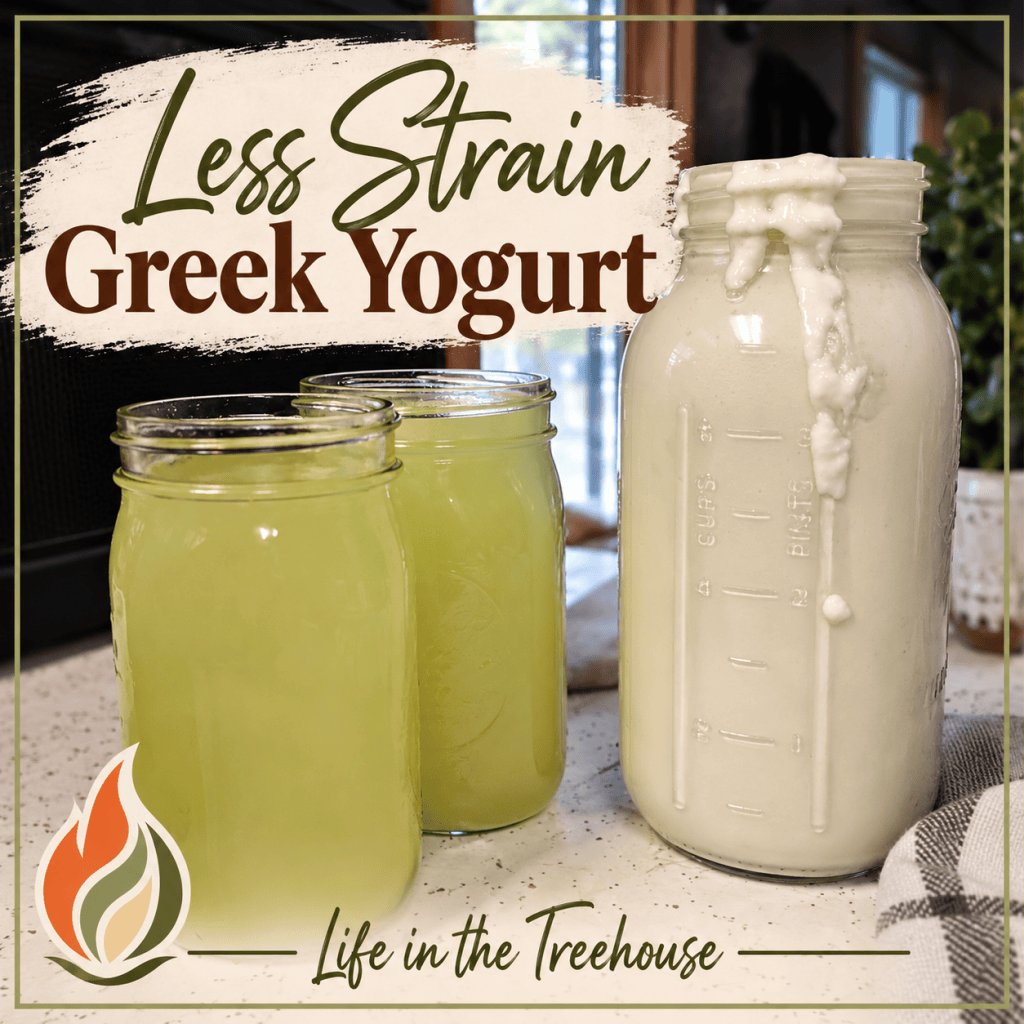
Somewhere along the way, I discovered that when I added baobab powder to my homemade yogurt, I consistently ended up with a firm set and a substantial amount of visible whey separation.
So I stopped automatically transferring the whole batch into a lined strainer.
I’ve had batches from which I could remove nearly half a gallon of whey without ever hanging a bag of yogurt.
No cheesecloth full of yogurt.
No strainers balanced over bowls.
No extra transfer step.
And significantly fewer things waiting for me at the sink.
There is still separation. There is simply less strain.
The Whey Is Part of the Yield
One of my favorite things about this process is that I don’t consider the whey a failure or a waste product. It’s another ingredient.
Around our house, it may become:
Cultured Lemonade
Liquid for soaking beans or gluten free grains
Smoothie liquid
Part of the liquid in baking
An ingredient in appropriate fermentation projects
Supplemental animal feed, when appropriate
I love kitchen processes where making one thing gives me the beginning of something else. One project quietly feeds another.
Affiliate Disclosure — Content Notice — Legal Disclosures — Newsletter — Home — Bottom of Post—TOP

Meet Gwen
I culture my yogurt in an Excalibur dehydrator. Her name is “Gwen.” As in Guinevere.
Because if the appliance is named after King Arthur’s sword, obviously somebody in the kitchen needed to be Gwen. The joke gets even better when you know that I’ve referred to my kitchen as the “war room” for years.
That name isn’t about fighting with my children over food…Quite the opposite.
My kitchen has been one of the safest places for me to make their food, and it has been one of the places where I have learned to fight for them and with them.
We’ve navigated celiac disease and cross-contact. We’ve read endless ingredient labels. We’ve worked with sensory needs, individual preferences, substitutions, changing tolerances, and all the ordinary complexities of feeding actual human beings rather than hypothetical ones.
A lot of advocacy has happened in this room.
A lot of protection has happened here, too.
Kind of fitting that I have “Swords“ and “Shields“ here.
Gwen also belongs to one of my favorite categories of kitchen equipment:
Appliances that work while I don’t.
My crockpots belong in this category.
My roaster oven belongs here.
So does my dehydrator…but there are so many to choose from.
I don’t evaluate kitchen equipment by whether somebody on the internet says I need it. I want to know what problem it solves.
Does it remove a source of frustration?
Does it save enough time or physical effort to matter?
Does it eliminate a bottleneck?
Can it handle the volume of food I’m actually making?
Will I use it often enough to justify the space it occupies?
And one of my favorites:
Can it keep working after I walk away?
That’s an enormous advantage in my season of life.
Sometimes the most valuable thing an appliance gives me isn’t speed.
It’s giving my attention back to someone, or something else.
Affiliate Disclosure — Content Notice — Legal Disclosures — Newsletter — Home — Bottom of Post—TOP
Less-Strain Greek Yogurt
Fuel Flow: Flexible Recipe
Makes: Approximately ½ gallon Greek-style yogurt, plus whey.
Ingredients:
1 gallon milk, any fat percentage
¼ cup baobab powder
2 cups plain yogurt with live active cultures
Directions:
1. Pour the milk into a large pot and bring it to a gentle boil.
2. Remove the milk from the heat and allow it to cool to an appropriate inoculation temperature for the live-culture yogurt or starter you are using. Follow the temperature guidance for your particular culture when available; adding the starter while the milk is too hot can damage the cultures.
3. In a separate bowl, whisk together the baobab powder, starter yogurt, and 1–2 cups of the cooled milk until well combined.
4. Stir the starter mixture thoroughly into the remaining milk.
5. Cover and place the yogurt in a reliably warm environment suitable for culturing yogurt. I use “Gwen,” my Excalibur dehydrator.
6. Culture until the yogurt is firmly set and has reached the tanginess you prefer. About 10 hours is typical in my kitchen, but culturing time can vary with your starter, temperature, and conditions.
7. Refrigerate the yogurt until thoroughly chilled.
8. Once chilled, carefully ladle off as much of the separated whey as desired. Removing more whey produces a thicker finished yogurt.
9. Stir gently until creamy. If you prefer an especially smooth texture, blend very briefly with an immersion blender.
10. Transfer the yogurt and whey to separate covered containers and refrigerate.
A Note About Raw Milk
If you’re beginning with raw milk, decide what matters to you about that milk before choosing your yogurt-making method.
The heating step in this particular recipe means it should not be assumed to preserve all of the characteristics for which someone might intentionally choose raw milk.
Lower-temperature culturing approaches also exist, but they have different considerations for culture performance, texture, and food safety.
If preserving particular characteristics of raw milk is important to you, research a method specifically designed for that purpose. Consider your milk source, the culture you’re using, current food-safety guidance, your household’s needs, and your own informed risk tolerance.
Different households may reasonably make different choices.
Affiliate Disclosure — Content Notice — Legal Disclosures — Newsletter — Home — Bottom of Post—TOP

The League of Extraordinary Microbes
If you’ve followed my microbial adventures for long, you know yogurt isn’t an isolated incident.
I’ve spent years experimenting with fermented foods and cultured kitchen projects: kombucha, milk kefir, water kefir, yogurt, gluten-free sourdough, ginger bugs, coconut milk kefir, cottage cheese, and more.
Collectively, I think of these microscopic kitchen helpers as my:
League of Extraordinary Microbes
I am endlessly fascinated by fermentation.
You create an environment.
You introduce or encourage the organisms you want.
You give them the conditions they need.
And then you wait while something you cannot even see transforms the food in front of you…you should totally go “start” something.
The Treehouse Standard
Safe, not sorry. Always.
My household is gluten-free, so the ingredients and products I choose are selected with our family’s boundaries in mind. Brands, formulations, manufacturing practices, and labels can change. Always verify the specific products you purchase against the food boundaries that matter in your own household.
Affiliate Disclosure — Content Notice — Legal Disclosures — Newsletter — Home —TOP



Nicole Burch is a Trim Healthy Lifestyle Coach, author, and holistic family life mentor helping women and families rebuild through rooted rhythms, personal governance, and sustainable living. Blending nourishment, discernment, and restoration, she guides others toward resilience, peace, and healing—creating lives that are grounded, aligned, and nurtured at home.
Wellness That Withstands.
Rooted. Resilient. Restored.
Affiliate Disclosure — Content Notice — Legal Disclosures — Newsletter — Home —TOP
Trim Healthy Coach Disclaimer
Nicole Burch is a Certified Trim Healthy Mama Lifestyle Coach, independently offering services based on the THM plan. This coach is not an employee or agent of Trim Healthy Mama, LLC. Coaching services are independently managed, and THM is not responsible for results, business practices, or claims made by this coach.
Affiliate Disclosures
As an Amazon Associate, I may link to specific products that I believe in and trust. This is an affiliate link, and I may receive a small commission at no additional cost to you.
As a Trim Healthy Affiliate I may link to specific products that I believe in and trust from Trim Healthy Mama, LLC. If you make any purchases through my link I may receive a small commission at no additional cost to you
As a Queen of Thrones Affiliate I may link to specific products that I believe in. If you make any purchases through my link I may receive a small commission at no additional cost to you.
River Hills Harvest and Azure Standard referral links may be linked to specific products or images on this blog. If you make any purchases through my link I may receive a small commission at no additional cost to you.







Leave a comment