
Affiliate Disclosure — Content Notice — Legal Disclosures — Newsletter — Home — Bottom of Post
⚠️ Content Warning: This post discusses child sexual abuse, sexual assault, trauma, infidelity, sexual addiction recovery, and the criminal justice system. It is intended for adult readers (18+). Please read with care and take breaks if you need them.
The Cost of Discomfort: What a Jury, a Trial, and My Children Taught Me
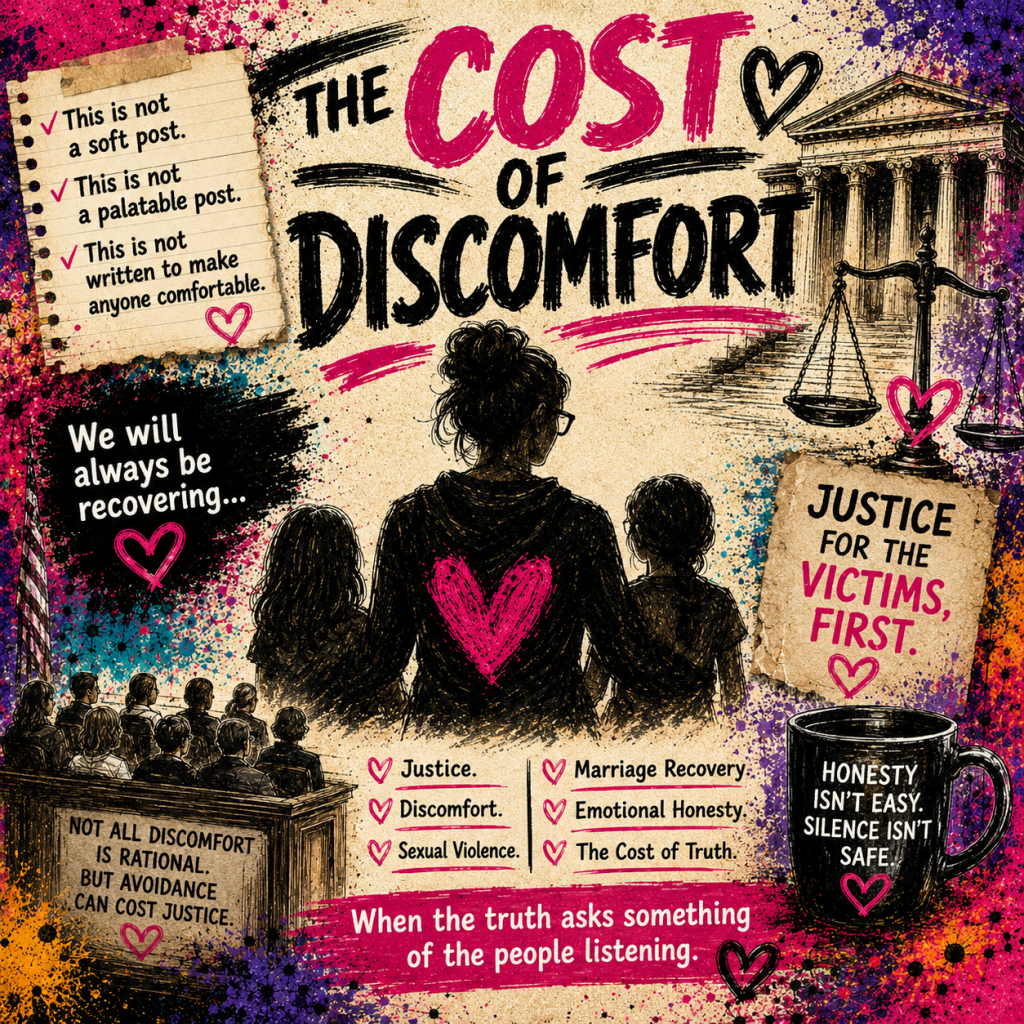
This is not a soft post. Please, read the Content Warning.
This is not a palatable post. I am exceedingly honest about my thoughts regarding the abuses my family have endured, and it has made people consider me “uncooperative” when I did during this experience.
This is not a post written to make anyone comfortable. We certainly weren’t and I strive to be real about things.
If you’re here for tidy conclusions, inspirational quotes, or a neatly wrapped story about healing, this isn’t that. We will always be recovering…
This is about justice. For the victims, first, because this was all for them.
It’s about discomfort in the midst of moving through incredible hurts and the process to obtain justice for those hurts.
It’s about the fallout of sexual violence.
It’s about marriage recovery, interrupted by life events.
It’s about emotional honesty, because I don’t know any other way to work through this.
And it’s about the cost of telling the truth when the truth asks something of the people listening, and the victims of harms nobody should have to endure.
Affiliate Disclosure — Content Notice — Legal Disclosures — Newsletter — Home — Bottom of Post — top
When Justice Is Partial
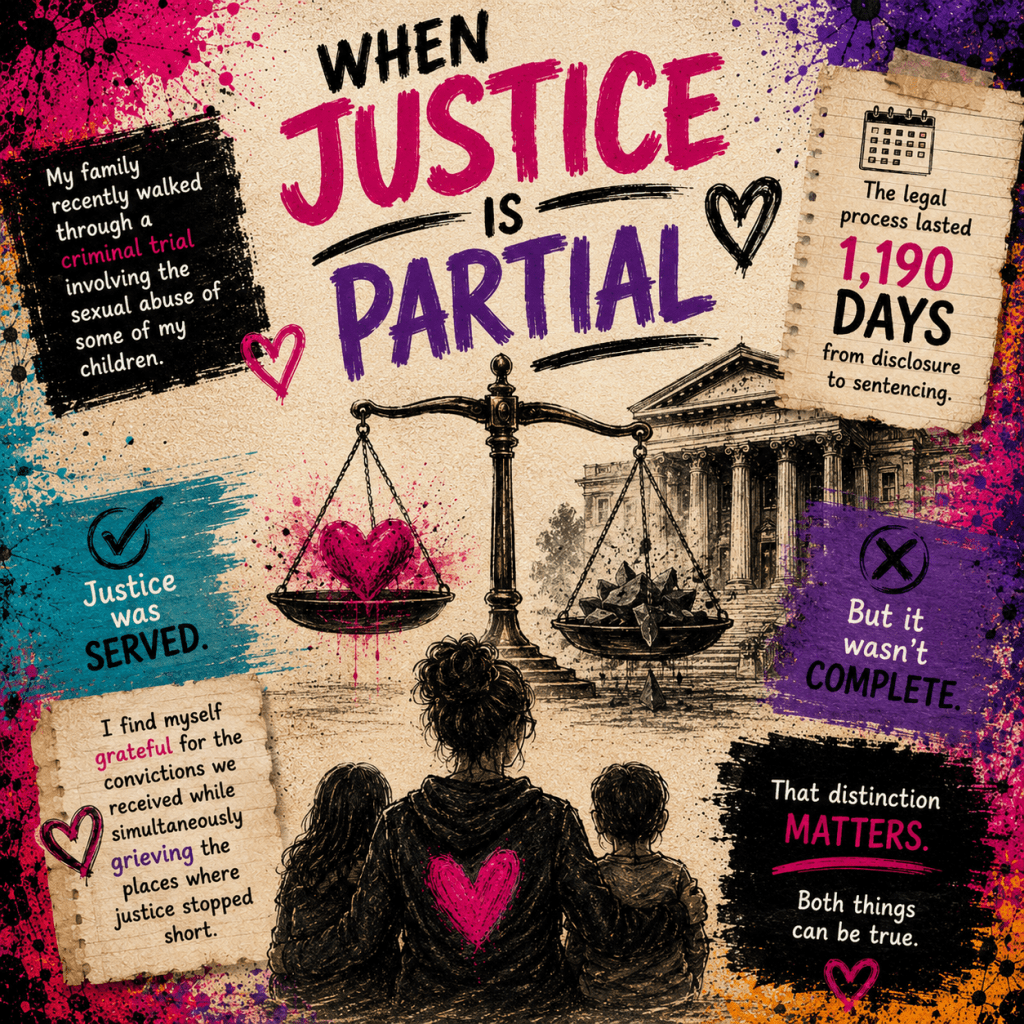
My family recently walked through a criminal trial involving the sexual abuse of some of my children.
The legal process lasted 1,190 days from disclosure to sentencing.
Justice was served.
But it wasn’t complete.
That distinction matters.
I find myself grateful for the convictions we received while simultaneously grieving the places where justice stopped short.
Both things can be true.
The Verdicts
We entered trial with six criminal counts to be considered by the jury.
We left trial with:
Three guilty verdicts.
Two hung counts.
One not guilty verdict.
Each guilty conviction carries a potential 100-year sentence, with parole eligibility no earlier than 25 years. The judge determined how those sentences would ultimately be served in sentencing months after the trial was complete.
The legal outcome was significant. I won’t ever be ungrateful for the jury seeing the truths of the situation.
It also left lasting questions for the prosecutors, victims, and our family. Some truths were glossed over by the “game” of cross-examination.
One reality I had to consider throughout the process was this:
There was a possibility that someday, decades from now, I could find myself standing before a parole board, once again advocating for my children against the man who abused them, to ask he remain behind bars.
Realistically, based on his age and health, that may never happen.
But carrying that possibility is its own weight when counting the cost of this process right now.
Affiliate Disclosure — Content Notice — Legal Disclosures — Newsletter — Home — Bottom of Post — top
The Counts That Hurt the Most
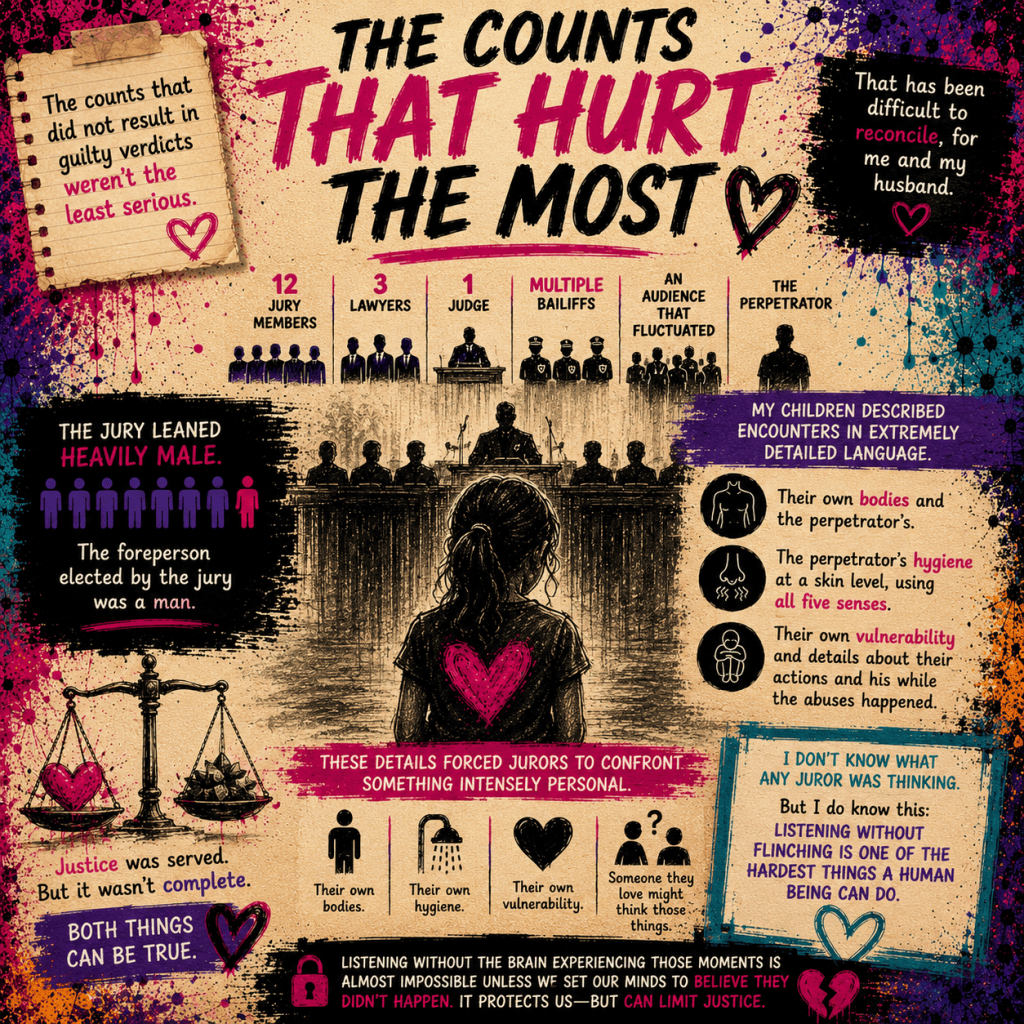
The counts that did not result in guilty verdicts weren’t the least serious.
They involved some of the most disturbing abuses my children disclosed.
That has been difficult to reconcile, for me and my husband.
I’ve spent a great deal of time reflecting on why.
Not because I believe I can know exactly what happened inside the jury room. I can’t.
But because after years of therapy, advocacy, and learning to tell the truth about uncomfortable things, I’ve also learned that human beings rarely make decisions untouched by emotion or prejudice of some kind.
What I Think Happened…as an observer
These are my reflections.
Not accusations. I have none, because they did their job as the jury.
Not certainty. I was not able to be present during my childrens’ testimony.
Simply observations from someone who sat through every day of trial…all five. Then, heard details from observers who were present during all the testimony.
My children testified with remarkable honesty. Sometimes painfully so.
They described experiences that were impossible to hear while trying to remain emotionally detached, in front of many strangers. Specifically the 12 person jury, 3 lawyers, judge, multiple bailiffs, the audience in the gallery which fluctuated in attendance as public trials do, and the perpetrator.
After the lawyers interviewed over 150 people on day 1 of trial, the jury leaned heavily male, and the foreperson elected by the jury was a man. That fact alone means nothing. But it exists within a larger human reality.
My children described encounters in language that was extremely detailed, beyond the surface level stuff.
They shared specific details about…
Their own bodies and the perpetrator’s beyond outside observations.
The perpetrator’s hygiene at a skin level, and their thoughts on that using all five senses…which honestly sounds terrifying without all the details.
Their own vulnerability, and details about their actions and his while the abuses happened.
In my opinion those explicit details required the adult men in the jury room to confront something intensely personal.
Not abstract anatomy. Their own bodies.
Their own hygiene.
Their own vulnerability.
The uncomfortable possibility that someone they loved—or had loved—might privately think similar things about them, that my child described with such clarity.
The women on the jury, many middle-aged or older, may have experienced something different, in my opinion.
Many likely have husbands.
Sons.
Brothers.
Grandsons.
Men they love deeply.
Men they trust.
Listening to testimony like that asks a person to imagine someone they love capable of profound harm, not just towards them, but others too.
That isn’t easy.
Those moments stop being theoretical, they stop being stories told to our children to set them up for safety, they stop being unimaginable.
They become deeply human, because now we know someone in front of us who experienced those things.
Again, I don’t know what any juror was thinking.
But I do know this:
Listening without flinching is one of the hardest things a human being can do.
Listening without the brain experiencing those moments, even theoretically, is almost impossible unless we set our minds to believe that they didn’t happen.
It’s how we protect ourselves, and it isn’t necessarily wrong, just short-sighted under these circumstances. They literally held the future of all six charges in their hands.
Affiliate Disclosure — Content Notice — Legal Disclosures — Newsletter — Home — Bottom of Post — top
Trauma Doesn’t Tell Stories in Straight Lines
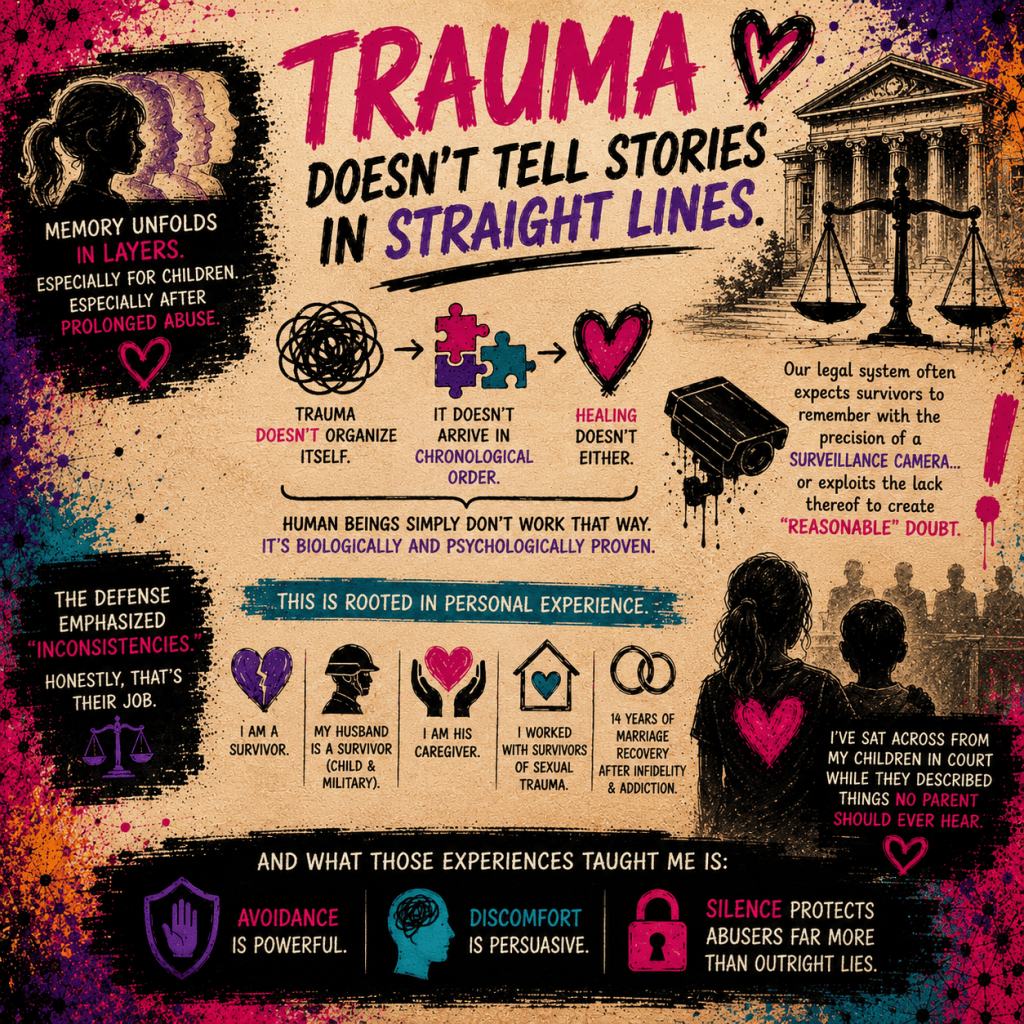
The defense emphasized inconsistencies. Honestly, that’s their job.
They pointed repeatedly to the fact that one of my children disclosed additional details months after the initial interview.
Anyone who works in trauma understands this isn’t unusual. The prosecution brought in an expert to underline this fact for the jury.
Memory often unfolds in layers.
Especially for children.
Especially after prolonged abuse.
Trauma doesn’t organize itself for courtroom efficiency.
It doesn’t arrive in chronological order.
Healing doesn’t either.
Human beings simply don’t work that way. It’s biologically and psychologically proven.
Yet our legal system often expects survivors to remember the worst moments of their lives with the precision of a surveillance camera…or exploits the lack thereof to highlight “reasonable” doubt, if they are representing someone who is “presumed innocent.”
I want this to be heard clearly…
People are capable of hurting other people, in varying degrees, for any reason or no reason at all.
This isn’t a criticism of men.
Is the perpetrator a man in this instance? Yes.
This isn’t feminism.
Do the victims in this case happen to be female? Yes.
This isn’t politics.
The only elected officials I cared about at the moment were those who were connected to my family’s journey to justice.
This is rooted in personal experience, from many sources…
I am a survivor of sexual assault.
My husband is a survivor of the same, both as a child and in his military career.
I am my husband’s caregiver due to his military trauma, and I worked in a group home for victims of sexual trauma for multiple years.
I have spent fourteen years inside a marriage recovering from infidelity, and the resulting uncovered sexual addiction that is being treated.
My husband and I have spent years in therapy learning how shame, avoidance, fear, and secrecy shape human behavior, specifically our own.
I’ve also sat across from my own children, and in a courtroom now, while they described things no parent should ever hear. And, I have held my husband while he recounted abuses done to him when he could…years after they happened.
None of this is theoretical for me. I often wish it was, for my sake and theirs.
And what those experiences taught me is:
Avoidance is powerful.
Discomfort is persuasive.
Silence often protects abusers far more effectively than outright lies.
Affiliate Disclosure — Content Notice — Legal Disclosures — Newsletter — Home — Bottom of Post — top
Listening Without Making It About Yourself
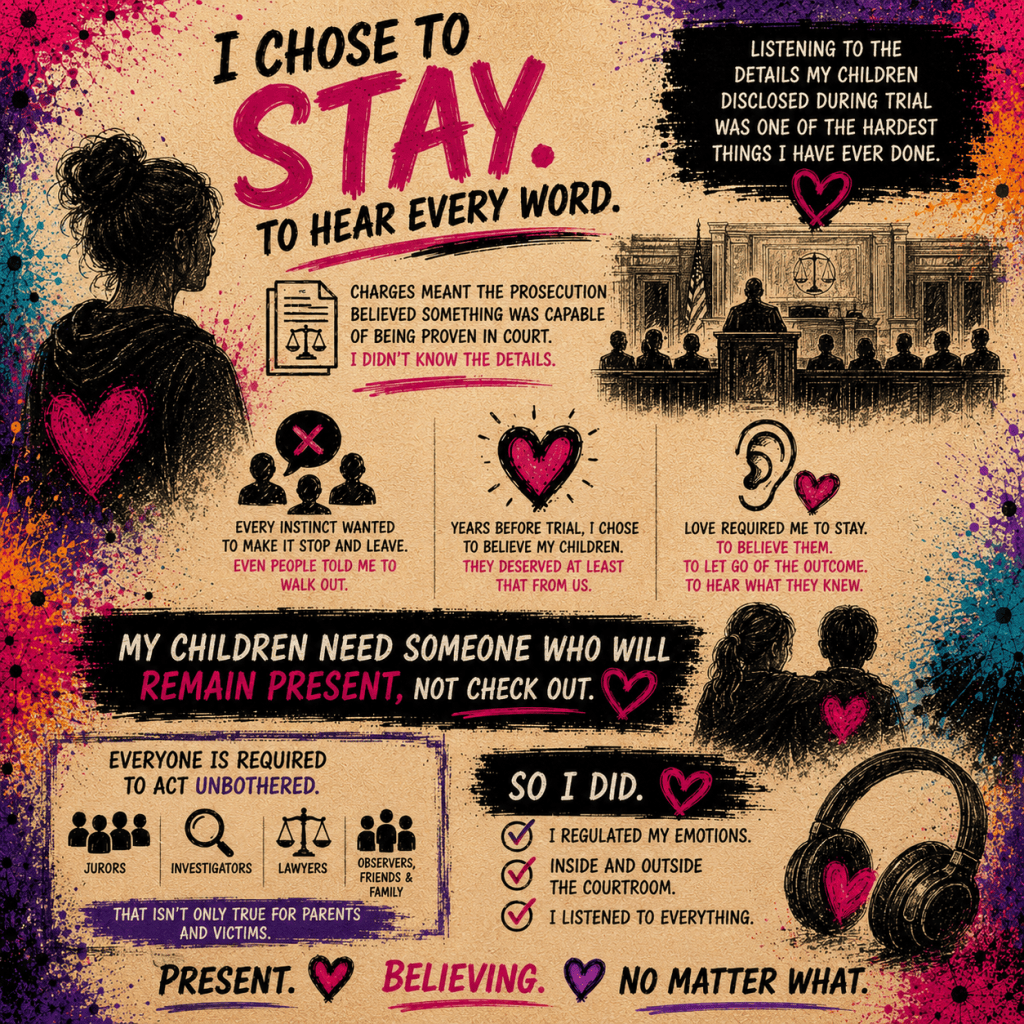
Listening to the details my children disclosed during trail was one of the hardest things I have ever done.
At the time, I only had a small understanding that charges meant that the prosecution believed something was capable of being proven during a trial, but not the specific details of this one.
Every instinct in me wanted to make it stop, and to leave. I was even told by a person who had been present for the testimony that I should walk out.
Not because I couldn’t handle it, not because I doubted them, but because I didn’t actually have to sit through it.
I had already chosen years before trial was even a thought, that if I was going to survive this process, I was going to do it believing my children experienced something painful, until proven otherwise. They deserved at least that from me and their father.
But love required something different from me in that moment, during closing statements.
It required me to stay…To hear every word.
To believe in them, and let go of the outcome that would be determined by these strangers who had no emotional connection to the outcome. Because, I had an emotional connection to it, and I wanted to know what they knew walking into that jury room.
My children need someone willing to remain present through the discomfort, without uninvited opinions, or checking out emotionally.
We learned that everyone is required to act as if they are unbothered from day one. It’s extremely frustrating as a participant and observer.
That isn’t only true for parents and victims.
It’s true for jurors.
Investigators.
Lawyers.
Casual trial observers, friends and family.
So, I did. I regulated my own emotions, both inside the courtroom and outside of it…for them. And I listened to everything.
Affiliate Disclosure — Content Notice — Legal Disclosures — Newsletter — Home — Bottom of Post — top
What This Trial Taught Me
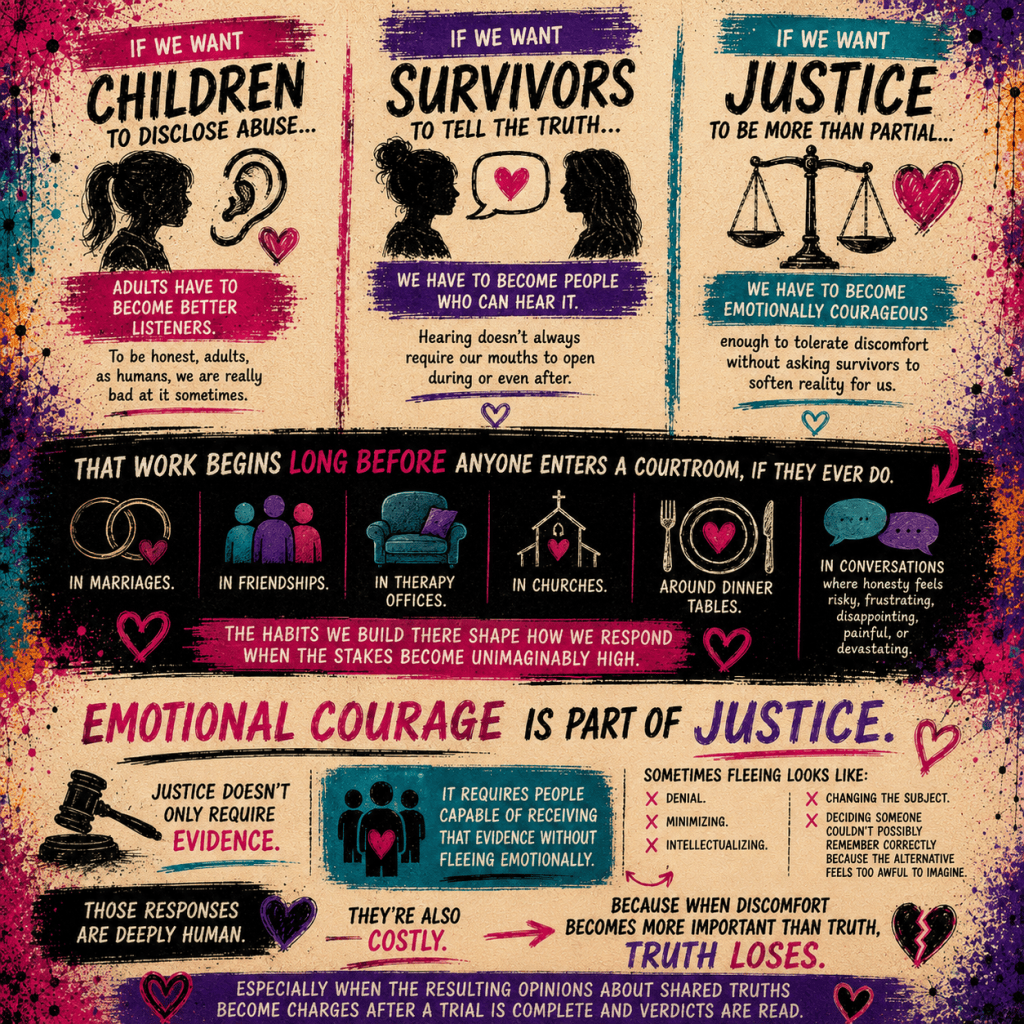
If we want children to disclose abuse…
Adults have to become better listeners. To be honest adults, as humans, we are really bad at it sometimes.
If we want survivors to tell the truth…
We have to become people who can hear it. Hearing doesn’t always require our mouths to open during or even after, and we need to recognize this better.
If we want justice to be more than partial…
We have to become emotionally courageous enough to tolerate discomfort without asking survivors to soften reality for us.
That work begins long before anyone enters a courtroom, if they ever do.
It begins in marriages.
In friendships.
In therapy offices.
In churches.
Around dinner tables.
In conversations where honesty feels risky, frustrating, disappointing, painful, or devastating to us or the person sharing with us.
The habits we build there shape how we respond when the stakes become unimaginably high.
Emotional Courage Is Part of Justice
Justice doesn’t only require evidence.
It requires people capable of receiving that evidence without fleeing emotionally.
Sometimes fleeing looks like denial.
Sometimes it looks like minimizing.
Sometimes it looks like intellectualizing.
Sometimes it looks like changing the subject.
Sometimes it looks like deciding someone couldn’t possibly remember correctly because the alternative feels too awful to imagine.
Those responses are deeply human. They’re also costly.
Because when discomfort becomes more important than truth, truth loses.
Especially when the resulting opinions about shared truths become charges after a trial is complete and verdicts are read.
Affiliate Disclosure — Content Notice — Legal Disclosures — Newsletter — Home — Bottom of Post — top
If You’ve Read This Far…Thank you.
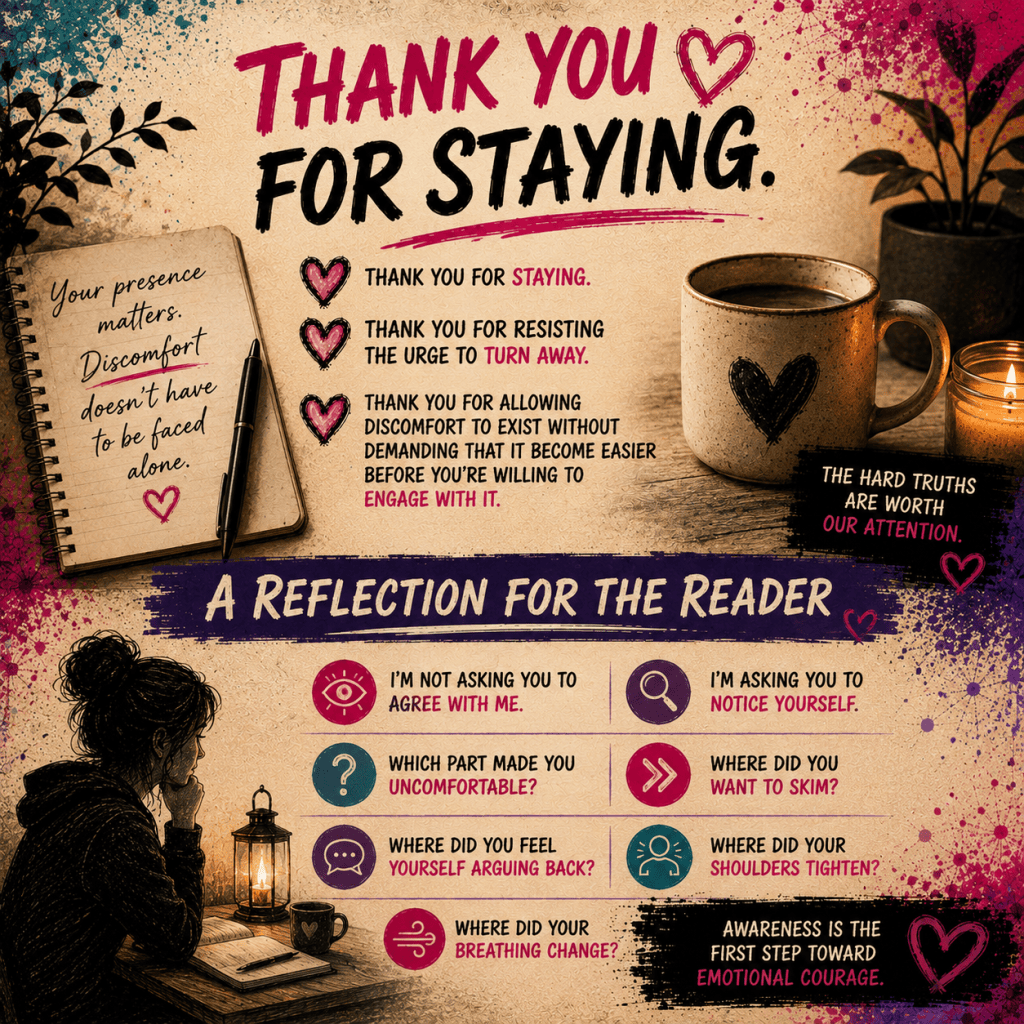
Thank you for staying.
Thank you for resisting the urge to turn away.
Thank you for allowing discomfort to exist without demanding that it become easier before you’re willing to engage with it.
That matters more than you know.

Get A FREE Printable Color-By-Number of this Image
A Reflection for the Reader
I’m not asking you to agree with me.
I’m asking you to notice yourself.
Which part made you uncomfortable?
Where did you want to skim?
Where did you feel yourself arguing back?
Where did your shoulders tighten?
Where did your breathing change?
Those reactions aren’t failures.
They’re information.
Discomfort doesn’t automatically mean something is wrong.
Sometimes it means we’ve encountered something we haven’t fully examined.
If we want a world where children are protected…
Where survivors are believed…
Where justice reaches further than partial victories…
Then we have to become people who can stay present when someone else’s truth challenges our own comfort.
You don’t need perfect words.
You don’t need immediate answers.
You don’t need to fix everything.
But you do need the courage to remain present.
Because silence doesn’t keep people safe.
Emotional numbing doesn’t keep people safe.
Too often, they keep systems comfortable.
And comfort has never been the goal.
Affiliate Disclosure — Content Notice — Legal Disclosures — Newsletter — Home — Bottom of Post — top
Where to Go from here
I don’t want to spend the rest of my life talking only about what happened to some my children.
But I absolutely intend to spend part of it talking about what we learned because it happened.
There is a difference.
Some of what I’ve learned belongs in advocacy.
Some belongs in parenting.
Some belongs in conversations about marriage, recovery, boundaries, family systems, and what it means to tell the truth when silence would certainly be easier.
And some of it belongs in resources I wish someone had handed me 1,190 days ago.
So, if you’ve made it this far and you’re wondering, Okay. What do I do with this?—there are a few places we can go together.
We Can Raise Children Who Know We Can Handle the Truth
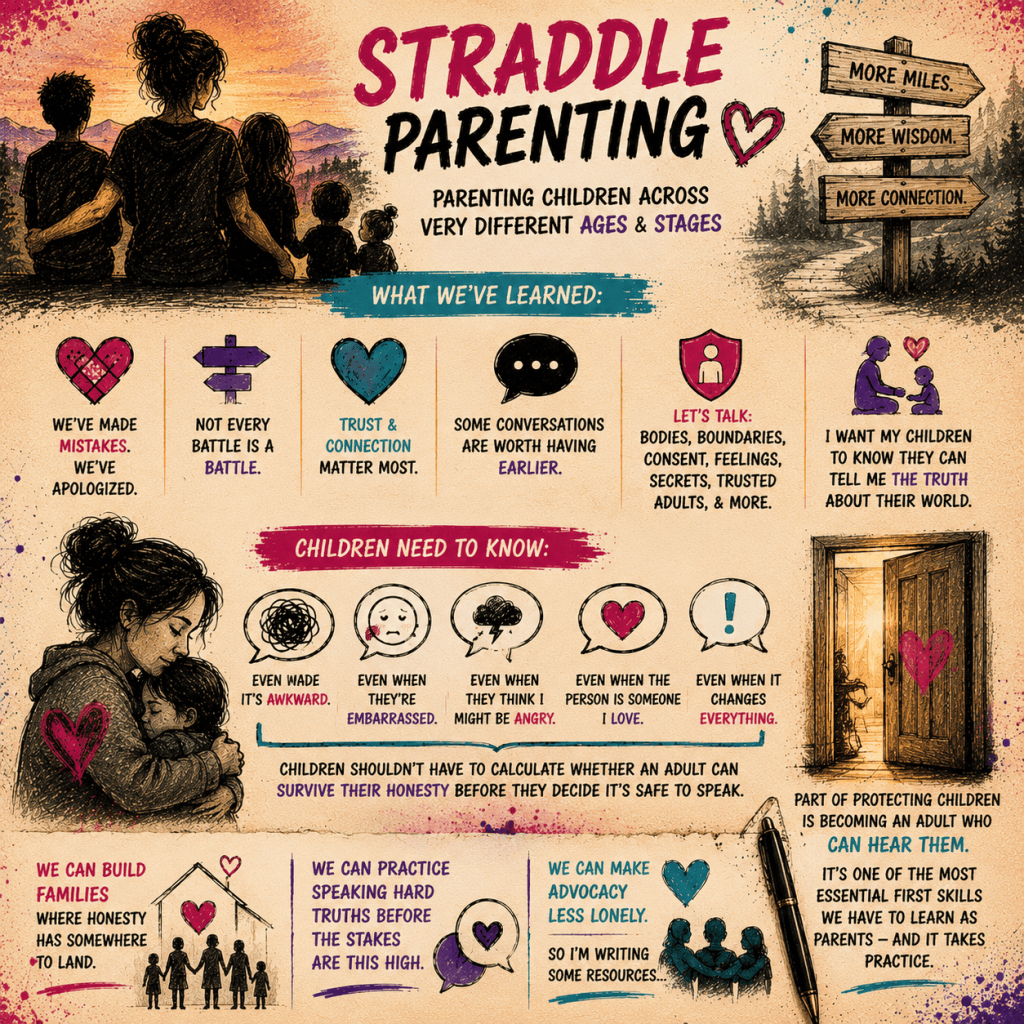
A lot of my parenting content lives in what I call Straddle Parenting—the strange position of parenting children across very different ages and stages at the same time.
One of the unexpected gifts of having younger children after you’ve already spent many years parenting is that those younger children don’t receive the same parents their oldest siblings did. They get parents with more miles on them.
We’ve made mistakes.
We’ve apologized.
We’ve learned which battles weren’t actually battles.
We’ve discovered that some of the things we once thought were really important weren’t nearly as important as preserving trust and connection.
We’ve also learned that there are conversations worth having earlier than we once imagined.
That includes learning how to talk about bodies, boundaries, consent, uncomfortable feelings, secrets, trusted adults, inappropriate behavior, and hard truths.
Not because I want my children growing up afraid of the world.
Quite the opposite. I want them growing up knowing they can tell me the truth about their world, as they experience and understand it.
Even when it’s awkward.
Even when they’re embarrassed.
Even when they think I might be angry.
Even when the person they’re talking about is someone I love.
Even when what they need to tell me changes everything.
Children shouldn’t have to calculate whether an adult can emotionally survive their honesty before they decide whether it’s safe to speak.
Part of protecting children is becoming an adult who can hear them. I now consider it one of the most essential first skills we have to obtain as a parent. The unfortunate part of obtaining this skill is that we have to practice it to be able to do that.
That’s something I’ll continue talking about in my parenting content—not from the perspective of having done everything perfectly, but from the perspective of having parented long enough to know better in some places, and choosing to do better because I know better in others.
>>We Can Build Families Where Honesty Has Somewhere to Land<<
What happens in a family when someone tells the truth?
>>We Can Practice Speaking Hard Truths Before the Stakes Are This High<<
You don’t begin learning how to have uncomfortable conversations when a child discloses abuse.
>>We Can Make Advocacy Less Lonely<<
So I’m writing some resources…
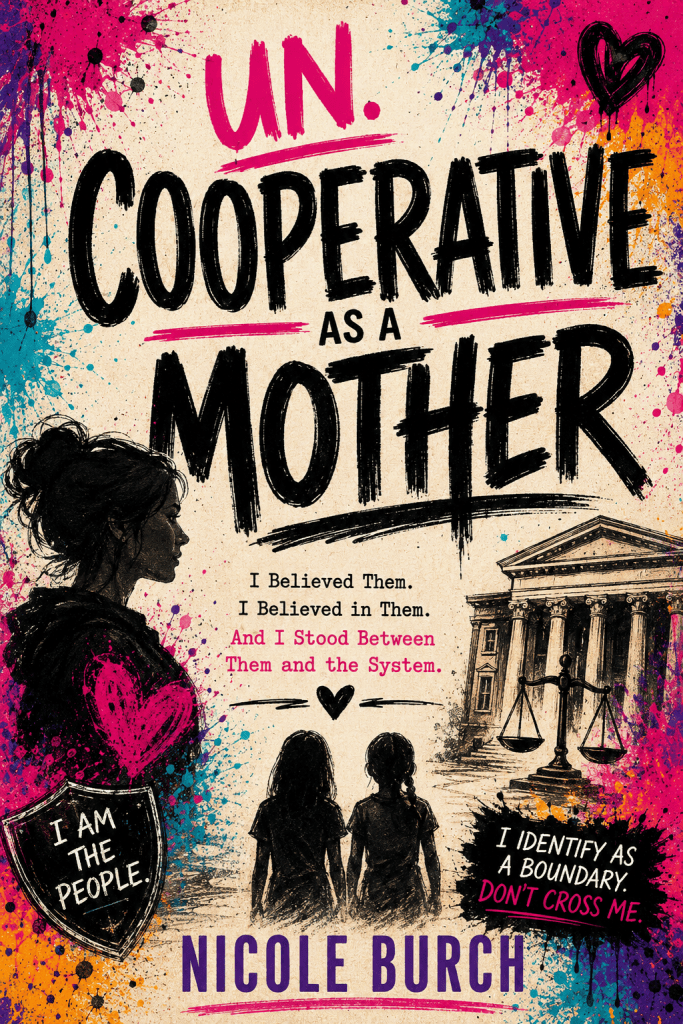
Uncooperative as a Mother tells the story of our family’s 1,190-day journey through the criminal justice system—from disclosure through sentencing—and what it meant to remain both mother and advocate inside a process that didn’t always understand the difference between cooperation and surrendering my children’s boundaries.
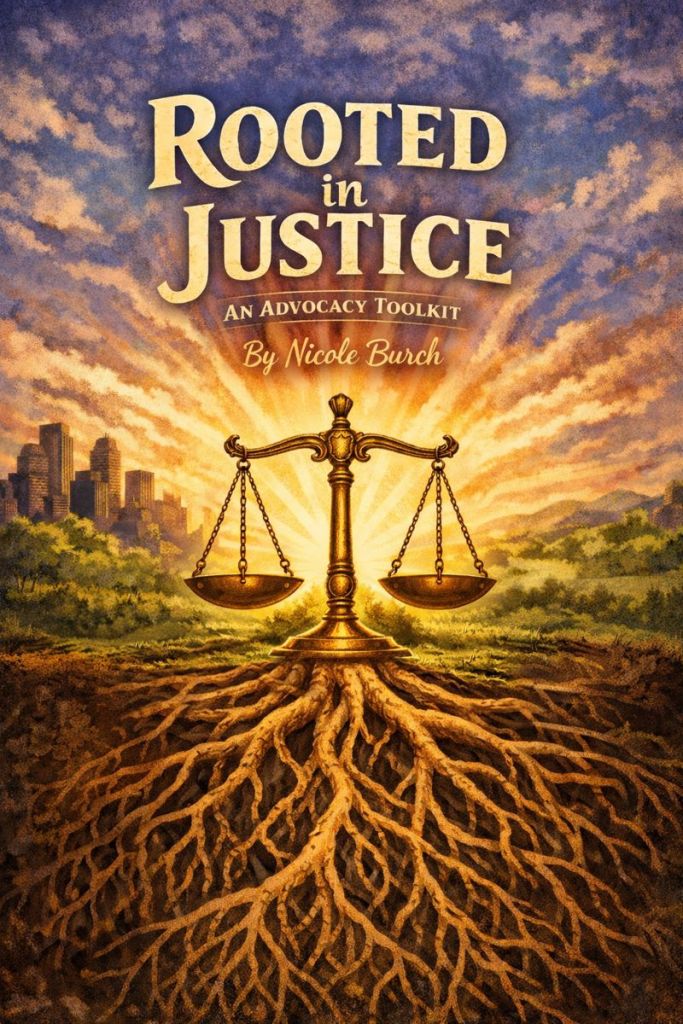
And Rooted in justice is intended to become the practical companion I wish I had been given at the beginning of our journey that ended in conviction and sentencing.
Not legal advice…
I’m building is the playbook nobody thought to hand me.
Because I can’t change what brought my family here.
But I can decide what I build from it.
You don’t need to consume all of it…
Start where your own life intersects with mine.
Take what helps. Leave what doesn’t.
Ask better questions because something here made you think.
Have a conversation with your child that you’ve been postponing.
Listen a little longer before you respond.
Believe that becoming more comfortable with uncomfortable truths is something we can actually practice.
Affiliate Disclosure — Content Notice — Legal Disclosures — Newsletter — Home — top



Nicole Burch is a Trim Healthy Lifestyle Coach, author, and holistic family life mentor helping women and families rebuild through rooted rhythms, personal governance, and sustainable living. Blending nourishment, discernment, and restoration, she guides others toward resilience, peace, and healing—creating lives that are grounded, aligned, and nurtured at home.
Wellness That Withstands.
Rooted. Resilient. Restored.


trim healthy coach disclosure
Nicole Burch is a Certified Trim Healthy Mama Lifestyle Coach, independently offering services based on the THM plan. This coach is not an employee or agent of Trim Healthy Mama, LLC. Coaching services are independently managed, and THM is not responsible for results, business practices, or claims made by this coach.
Content Notice — Legal Disclosures — Newsletter — Home — top
Affiliate Disclosures
As an Amazon Associate, I may link to specific products that I believe in and trust. This is an affiliate link, and I may receive a small commission at no additional cost to you.
As a Trim Healthy Affiliate I may link to specific products that I believe in and trust from Trim Healthy Mama, LLC. If you make any purchases through my link I may receive a small commission at no additional cost to you.
As a Queen of Thrones Affiliate I may link to specific products that I believe in. If you make any purchases through my link I may receive a small commission at no additional cost to you.
River Hills Harvest and Azure Standard referral links may be linked to specific products or images on this blog. If you make any purchases through my link I may receive a small commission at no additional cost to you.












Leave a Reply